

Welcome
Dear colleagues,
Welcome to the second newsletter from the Communications Committee of the World Falls Prevention Society. This week is falls awareness week in many parts of the world. We have been busy spreading the word about fall prevention and the work of the Society on Instagram @worldfallssociety and we are now on LinkedIn and Facebook. Connect with us today! We’ve also been promoting the 3rd World Falls Congress, coming up in June 2026 in Manchester, UK.
We hope you enjoy the newsletter!
Best wishes,
Professor Anne Tiedemann and Professor Maw Pin Tan,
on behalf of the World Falls Prevention Society Communications Committee

MISSION AND OBJECTIVES OF THE WORLD FALLS PREVENTION SOCIETY
The purpose of the World Falls Prevention Society (WFPS) is to promote the multidisciplinary study and implementation of fall prevention in older people and clinical groups with balance impairment.
OUR OBJECTIVES ARE:
- To plan and organise WFPS congresses, symposia and meetings.
- To present and discuss the latest research and clinical findings relating to fall risk factors and fall prevention strategies.
- To facilitate student participation at WFPS congresses through travel grants, low registration fees and presentation awards.
- To provide members with email notifications about upcoming WFPS congresses and other occasional email updates.
- To facilitate interaction between members who meet from across the world.
- To foster links with similar societies and networks around the world.
- To promote the broad discipline of fall prevention research.
- To translate fall prevention into practice and policy through guidelines, advocacy and education.
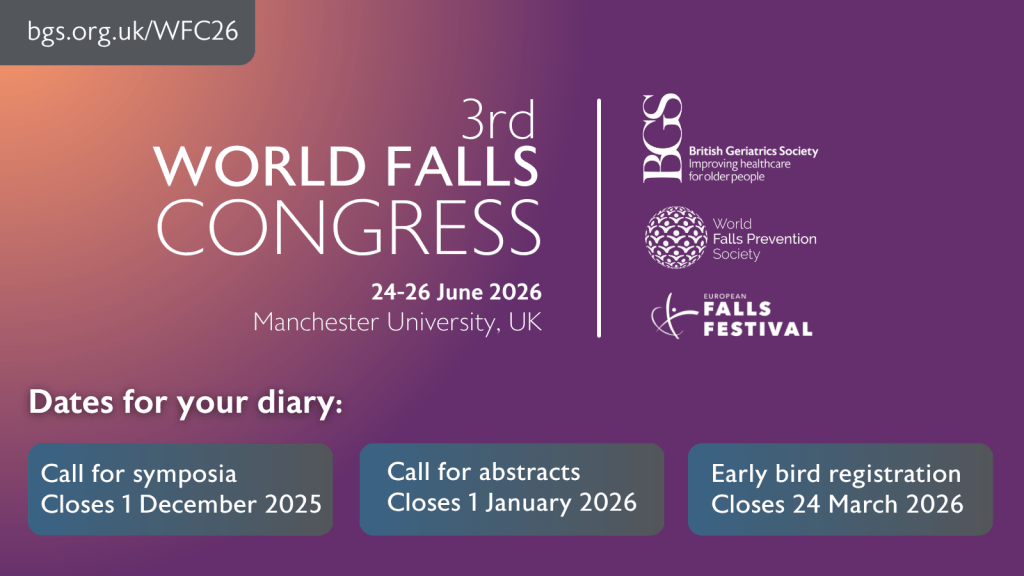
REGISTRATIONS FOR THE 3RD WORLD FALLS CONGRESS ARE NOW OPEN
We are looking forward to the World Falls Congress in June 2026! Make a note in your diary of the key dates and we look forward to seeing you in Manchester!
Programme themes:
This conference will cover core areas of interest to all specialists responsible for the healthcare of older people with a particular focus on:
- Falls Prevention
- Treatment of older people who have undergone a fall
- Rehabilitation – in hospital and the community
Invited speakers:
Professor Andy Clegg, University of Leeds, United Kingdom.
Topic: eFalls predictions
Professor Dr Devinder Kaur Ajit Singh, Universiti Kebangsaan, Malaysia.
Topic: Falls prevention in LMIC
Professor Manuel Montero-Odasso, University of Western Ontario, Canada.
Topic: Low risk does not mean no risk
Dr Yoshiro Okubo, University of New South Wales, Australia.
Topic: Reactive balance and virtual reality training
Professor Cathie Sherrington, The University of Sydney, Australia.
Topic: Healthy ageing e-health intervention
Professor Dawn Skelton, Glasgow Caledonian University, United Kingdom.
Topic: Falls prevention exercise as medicine: Fidelity and dose matter!
Dr Lara Mitchell, Queen Elizabeth University Hospital, United Kingdom.
Topic: Syncope and cardiovascular disease and the link to falls
Dr Toby Ellmers, Imperial College London, United Kingdom.
Topic: Fear of falling
Dr Louise Tomkow, Salford Royal hospital, United Kingdom.
Topic: Falls presenting to A& E
Professor Celia Gregson, The Health Research Unit of Zimbabwe, Zimbabwe.
Topic: Osteoporosis and fracture risk management
Professor Kathryn Sibley, University of Manitoba, Canada.
Topic: Balance outcome measures
Professor Bo Abrahamsen,University of Southern Denmark, Denmark.
Topic: Vitamin D and falls/fractures
OTHER UPCOMING CONFERENCES
Gerontological Society of America annual scientific meeting, 12-15 November 2025, Boston, USA. https://www.gsa2025.org/
Australia and New Zealand Falls Prevention Society conference, 26-28 November 2025 Sydney, Australia. https://anzfpconference.com.au/
International Association of Geriatrics and Gerontology, 5-8 July 2026, Amsterdam, The Netherlands. https://www.iagg2026.org/
SOCIAL MEDIA
The World Falls Prevention Society is active on social media. Please follow us on Instagram, Bluesky, Facebook and LinkedIn, like and share our posts, and help us to spread the word about fall prevention!
Instagram: @worldfallssociety
Bluesky: @worldfallssociety.bsky.social
Facebook: World Falls Prevention Society
LinkedIn: World Falls Prevention Society
Do you have new publications or announcements you would like to share on our Instagram account? Please send any content you would like posted to dabreu@fmrp.usp.br
Join our Society
There are many benefits to becoming a member of the World Falls Prevention Society including discounted rates on conferences, webinars and meetings, access to online resources and the opportunity to get involved within the Society through voting or standing in annual elections.
Member categories include regular members ($250 AUD), student and post-doctoral members ($125 AUD) and developing nations members (complimentary). Membership dues are a two year membership, starting January 1 and expiring December 31st of the second year. The current membership period expires December 31, 2026.
For more information visit worldfallssociety.org/membership
Relevant publications relating to the implementation of the World Falls Guidelines
- Delbaere K, Sherrington C, Said CM, Naganathan V. Innovative approaches to fall prevention in community‐dwelling older adults. Medical Journal of Australia. 2025; 223 (4): 174-176 (doi: 10.5694/mja2.52714)
This perspective highlights recent innovations that have the potential to deliver scalable, accessible and sustainable fall prevention solutions, and provides recommendations to inform policy and future research priorities towards a meaningful, system-wide impact. - Delbaere K. A smarter approach to fall prevention: insights for action. Age and Ageing. 2025; 54 (3): afae291: 1-3 (doi: 10.1093/ageing/afae291)
This Editorial highlights that intermediate risk is a pivotal window for timely, low-cost fall prevention. Combining questions (e.g., 3KQs) with mobility assessments improves identification and stratification, enabling efficient fall prevention that emphasises self-management for most older adults. - Ellmers TJ, Ventre JP, Freiberger E, Hauer K, Hogan DB, Lim ML, McGarrigle L, Nyman SR, Todd C, Li Y, Delbaere K. Does concern about falling predict future falls in older adults? A systematic review and meta-analysis. Age and Ageing. 2025; 54 (4): afaf089: 1-12 (doi: 10.1093/ageing/afaf089)
This review of 53 prospective studies (75,076 participants) confirms that concern about falling predicts future falls, independent of age, prior falls or physical function. Using Bradford Hill criteria, it establishes concern as a causal risk factor, resolving a 20-year debate and providing GRADE 1A evidence for its inclusion in fall risk screening. - Taylor ME, Ambrens M, Hawley-Hague H, Todd C, Close JCT, Lord SR, Clemson L, Lung T, Berlowitz D, Blennerhassett J, Dayhew J, Gluchowski A, Hodge W, Johnson P, Lasrado R, Merlene M, Miles L, O’Rourke S, Said CM, White L, Wilson N, Zask A, Delbaere K. Implementation of a digital exercise programme in health services to prevent falls in older people. Age and Ageing. 2024. 53 (8), afae173: 1-12 (doi: 10.1093/ageing/afae173)
This international implementation trial, conducted across regional NSW, VIC and UK (10/19-04/22), successfully implemented an unsupervised, home-based digital fall prevention program in clinical practice. - Ambrens M, Macniven R, Perram A, Andrews S, Hawley-Hague H, Razee H, Todd C, Valenzuela T, Delbaere K. How Perceptions of Aging Influence Physical Activity and Exercise in Older Age: Exploring the Behavior of People Aged 70+ Years Engaged in Fall Prevention Activities. Journal of Applied Gerontology.2024; 43(10): 1386-1396. (doi: 10.1177/07334648241238315)
This study shows that perceptions of ageing are the overarching driver shaping older adults’ physical activity preferences and exercise delivery, and provides actionable guidance for designing and delivering inclusive fall prevention programs. - Pieruccini-Faria F, Son S, Zou GY, Almeida QJ, Middleton LE, Bray NW, Lussier M, Shoemaker JK, Speechley M, Liu-Ambrose T, Burhan AM, Camicioli R, Li KZH, Fraser S, Berryman N, Bherer L, Montero-Odasso M. Synergistic effects of exercise, cognitive training and vitamin D on gait performance and falls in mild cognitive impairment—secondary outcomes from the SYNERGIC trial. Age and Ageing, 54(9), p.afaf242. (doi: 10.1093/ageing/afaf242)
In older adults with mild cognitive impairment, a 20-week program of aerobic–resistance exercise combined with computerized cognitive training improved walking capabilities and reduced fall risk. Vitamin D supplementation offered no additional advantage and was associated with increased walking instability, suggesting potential harm. - Montero-Odasso M, Pieruccini-Faria F, Son S, Carvalho de Abreu DC, Hunter S, Liu JQ, Moore M, Hezam A, Van Der Velde N, Masud T and Ryg J. 2025. Fall risk stratification in older adults: low and not-at-risk status still associated with falls and injuries. Age and ageing, 54(3), p.afaf064.(doi: 10.1093/ageing/afaf064)
This study showed that 41% of older adults classified as not-at-risk experienced falls, with 63% of them resulting in injuries. Slow gait speed (<1m/s) doubled the risk of injurious falls, suggesting that routine gait speed assessments could improve falls risk detection. - Montero-Odasso M, Van Der Velde N, Ryg J and Masud T. 2025. Falls risk stratification. One size doesn’t fit all. Age and Ageing, 54(1), p.afae292.(doi: 10.1093/ageing/afae292)
This editorial argues that standard fall risk tools may overlook many older adults who still experience falls, emphasizing that an uniform approach is insufficient, it advocates for more individualized assessments that consider factors like gait speed and functional mobility to better identify those at risk. - Dawson R, Pinheiro M, Oliveira J, Haynes A, Naganathan V, Taylor ME, Bowes N, Nelson K, Rayner J and Sherrington C. (2025), The Telephysiotherapy for Older People (TOP-UP) program for improving mobility in people receiving aged care: a hybrid type 1 effectiveness–implementation randomised controlled trial. Medical Journal of Australia, 223: 205-213. (doi: 10.5694/mja2.70004)
This randomised controlled trial demonstrated that the TOP-UP (Telephysiotherapy for Older People) program, a six-month telehealth program, improved mobility, reduced falls and pain, and enhanced quality of life for older adults receiving aged care in Australia. The study suggests telephysiotherapy is a safe, effective, and scalable solution for aged care settings, especially where in-person physiotherapy is limited. - Oliveira JS, Sherrington C, Lord SR, Camara GC, Colley S, West CA, Haynes A, Gilchrist H, Kwok WS, Pearce LMN, Wallbank G, Trent M, Bauman A, Grunseit AC, Anstey KJ, Tiedemann A. The effect of an Iyengar yoga-based exercise programme versus a seated yoga relaxation programme on falls in people aged 60 years and older (SAGE): a pragmatic, two-arm, parallel randomised controlled trial. The Lancet Healthy Longevity, 2025. (doi :10.1016/j.lanhl.2025.100749)
This randomised controlled trial (n=700) demonstrated that the SAGE Iyengar yoga-based exercise program improved balance confidence, physical activity and goal attainment but also led to a significant increase in falls (IRR 1.33). - Seppala LJ, Frith J, Skelton DA, Becker C, Blain H, Kenny RA, Linn AJ, Ryg J, Arnadottir SA, Bahat G, Bonnici M, Mora MÁC, Dionyssiotis Y, Frankenthal D, Hartikainen S, Helbostad JL, Herrero AC, İlhan B, Jonsdottir AB, Markovski M, Roller-Wirnsberger R, Ruggiero C, Saltvedt I, Skalska A, Smedberg D, Soulis G, Szczerbińska K, Topinkova E, Veninšek G, Vlaeyen E, Ylli A, van der Velde N; European Geriatric Medicine Society Special Interest Group on Falls and Fractures. Challenges and opportunities for falls prevention: an online survey across European healthcare professionals. Eur Geriatr Med. 2025 Aug;16(4):1269-1282. (doi: 10.1007/s41999-025-01237-5.)
This survey of healthcare providers in 34 European countries (N=1669) found that only 27% believed their undergraduate education adequately prepared them for clinical practice in this area. 76% reported opportunistically screening older adults for falls risk often or always during consultations. Gait and balance assessment was the most frequently performed component of the multifactorial falls risk assessment. There was regional and country-level variation in barriers and facilitators to implementing the World Falls Guidelines. It is essential to educate and engage governmental bodies and insurers to secure their support and prioritization of falls prevention initiatives. - Ventre JP, Manning F, Mahmoud A, Brough G, Timmons S, Hawley-Hague H, Skelton DA, Goodwin VA, Todd CJ, Kendrick D, Logan P, Orton E. Factors influencing fall prevention programmes across three regions of the UK: the challenge of implementing and spreading the Falls Management Exercise (FaME) programme in a complex landscape. Age Ageing. 2025 Mar 28;54(4):afaf083. (doi: 10.1093/ageing/afaf083.)
This study interviewed commissioners and service providers of an evidence-based falls prevention exercise programme, FaME, in the UK and explored factors affecting the adoption, implementation and spread of the programme. For adoption and implementation to be facilitated, FaME programmes must demonstrate effectiveness and fit the local needs of those receiving the intervention. For spread to occur, influential decision-makers and funders must support wider programme rollout whilst also securing sufficient expert capacity to deliver the programme and ensure monitoring is in place to determine effectiveness of provision for older adults.
 worldfallssociety.org